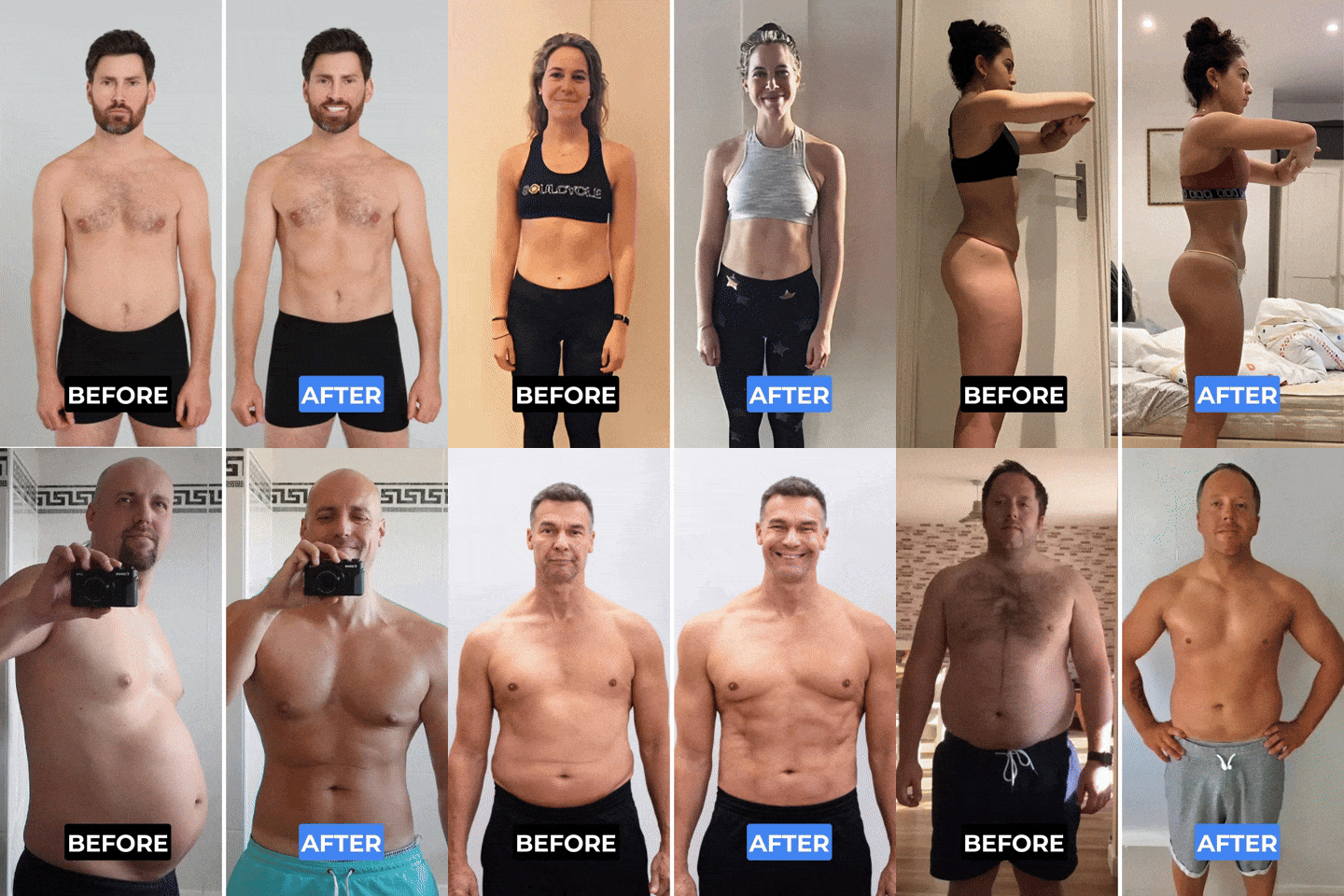
Physical Therapist: "My Clients With the Most Toned Abs Don't Do Crunches. They Used This Device for 20 Minutes a Day Instead."

I've been a physical therapist for over a decade.
I've watched thousands of people train, recover, and rebuild.
And a few years ago, I started noticing something that quietly drove me crazy.
The clients with the most toned, defined cores were almost never the ones doing the core workouts everyone tells you to do.
They weren't running crunch programs or doing planks every morning. They weren't buying the ab wheels or the 30-day challenges. Some of them told me flat out they hadn't trained abs in years.
Meanwhile, the people grinding through hundreds of crunches a week were coming in frustrated, asking why their midsection wouldn't change.
That's backwards. That's not how effort is supposed to work.
So I did what clinicians do when a pattern won't leave them alone.
I started keeping track.
The Pattern I Couldn't Ignore

Over months, the picture sharpened.
The people with the defined midsections had something in common, and it had nothing to do with willpower, genetics, or gym hours.
They were all using the same machine.
It's something we've had in clinical settings for years: you strap it on, and it works a muscle for you while you lie there.
I'd watch it happen. Their stomach muscles would tighten and release, again and again, for 20 minutes straight, while they scrolled their phones.
They weren't exercising. The machine was doing the work.
I'd walked past these sessions my whole career. What I'd never done was connect them to what was showing up in the mirror.
The Physiology That Explains It

To understand what I was seeing, you need one fact about your own body. It's simple, and almost nobody outside my profession ever learns it.
Every muscle in your body runs on electrical signals.
Your brain fires a tiny signal. The signal travels down a nerve. When it arrives, the muscle contracts, meaning it tightens hard.
Every movement you've ever made works this way. A crunch is your ab muscles contracting. A squat is your leg muscles contracting. Even a blink is a contraction.
Signal arrives, muscle contracts. That's the whole system.
Now the second fact, and this is the one that explains the frustrated crunchers.
Your brain is lazy on purpose.
When you do a crunch, your brain uses as few muscle fibers as it can get away with. It leans on the surface muscle it already knows. The deep fibers, the ones that create the tight, defined look, don't even get touched.
You can do a thousand crunches and never fully wake those fibers up. Not because you're weak. Because your own body is saving energy without asking you.
That's the wall my frustrated clients kept hitting. They were sending maximum effort through a system designed to spend minimum energy.
What the Machine Does Differently

The clinical sessions I kept observing solve that exact problem, and they solve it in the most direct way imaginable.
The machine delivers the signal itself.
A controlled impulse passes through the skin to the deep nerves, the same pathway the brain uses, and the muscle contracts. Fully. All the fibers, deep and surface, together.
There's zero motivation involved and zero form to master. The muscle simply receives the signal and does what muscle has always done.
And it does it hundreds of times in a single session.
That's why my six-pack abs clients looked the way they did. They'd been getting hundreds of complete, deep contractions per session, reaching fibers their crunches could never reach.
Their results weren't a mystery. They were doing more core work in 20 minutes of lying down than most people do in a month of gym visits.
Where This Has Been Hiding in Plain Sight

Here's the strange part. This machine was never rare.
Once I understood what it was doing for my clients, I started noticing it in every professional setting I'd ever worked in. Physical therapy clinics have it. Athletic training rooms have it. Military PT programs use it. It's been standard equipment for decades.
It's called NMES. Neuromuscular electrical stimulation.
You've probably never heard the name for one reason: it lived behind clinic doors, attached to appointment books and per-session billing.
Then the Clinic Wall Came Down

Here's why I'm writing this now.
In the last few years, clinical-grade NMES became available for home use.
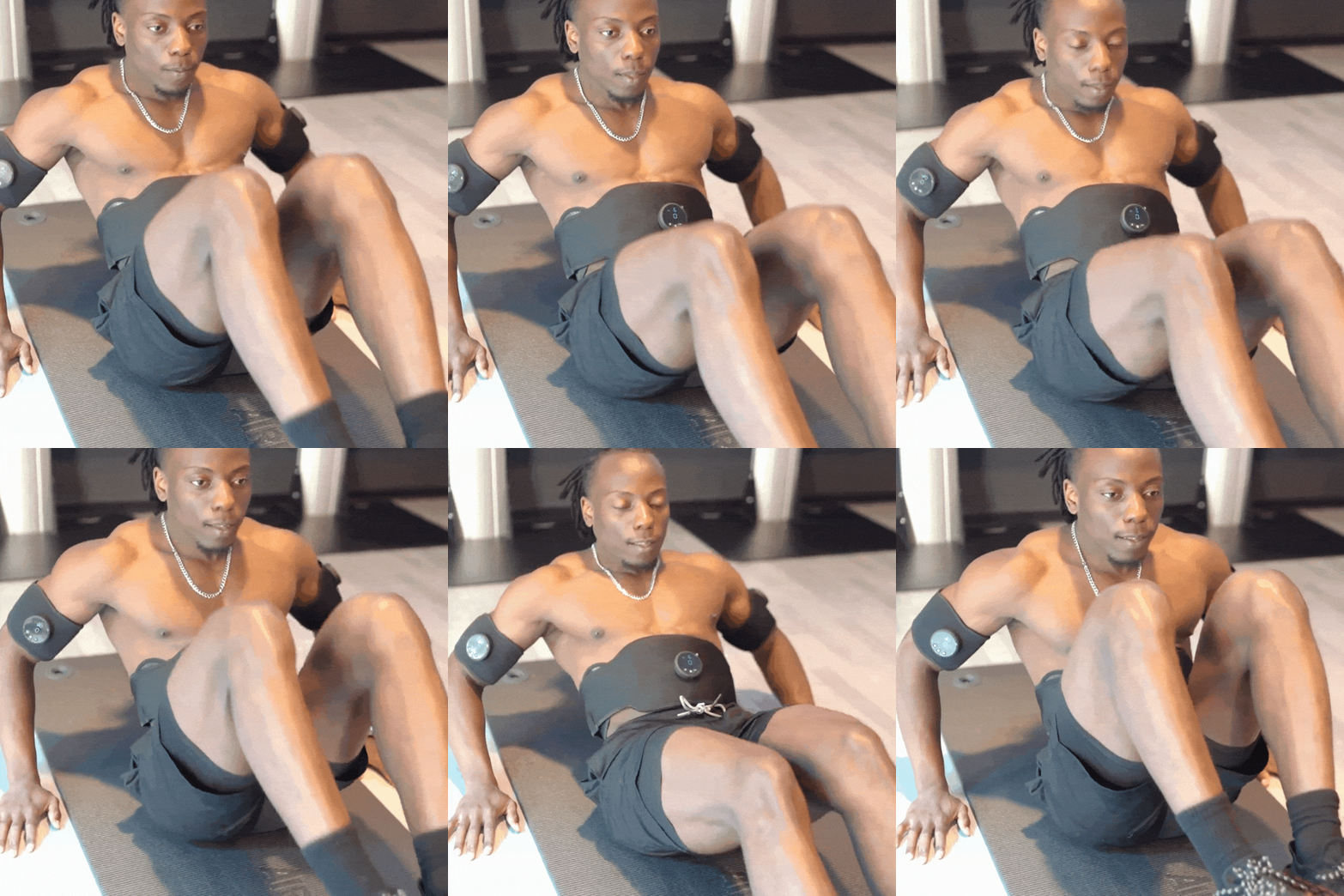
The version I point people to is called the Ultra Stimulator. It's FDA-cleared as a Class II device, the same FDA category as equipment used professionally. The signal itself is patented. And there's nothing to maintain: it's fully wireless, with nothing to ever refill or replace. You strap it on and press start.
One 20-minute session delivers over 600 deep contractions while you sit, cook, or work.
- ✓FDA-cleared Class II device — the same FDA category as equipment used professionally
- ✓Patented signal — a full, deep contraction, not a tingle
- ✓Fully wireless — nothing to ever refill or replace
- ✓600+ deep contractions in one 20-minute session
- ✓Owned by more than 115,000 people — recommended by over 452 clinicians through FrontRowMD
What to Expect, Week by Week
Muscle changes on a schedule. Here's the one I give people:
Week one: you wake up sore in your deep core. That soreness is the proof: the deep fibers finally fired.
Weeks two to three: your midsection feels tighter through the day.
By 60 days: the toning shows. In a survey of Ultra owners, 94% reported visible toning within 60 days.
The protocol is a few 20-minute sessions a week. Sitting down.
Don't Just Take My Word for It
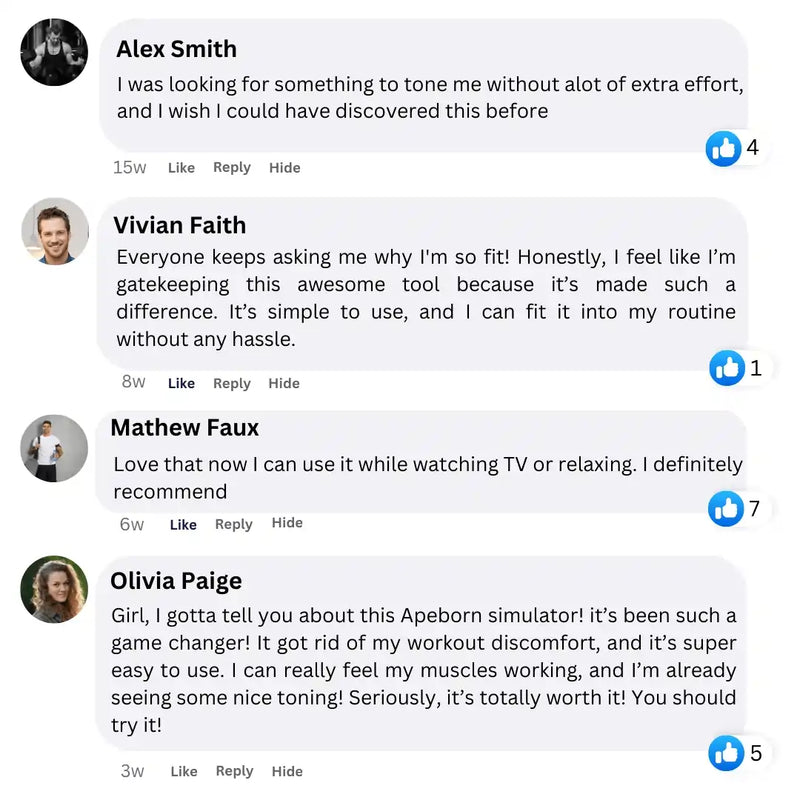
“I recommend this product and this company. I can see my abs getting tighter and my ab muscles are beginning to pop after just two weeks of use. Thank you Ape Born!”
“After six months of using this Stimulator along with a balanced diet, I can honestly say this little device has exceeded my expectations. I've been using it almost daily, mainly on my arms and core, and the results are noticeable!”
“This is my 8 months journey while hitting the gym along with using these stimulators. The best part is it has velcro straps and not the gel pads like others. It surely is expensive than other machines out there but is worth the price.”
Try It the Way a Skeptic Would
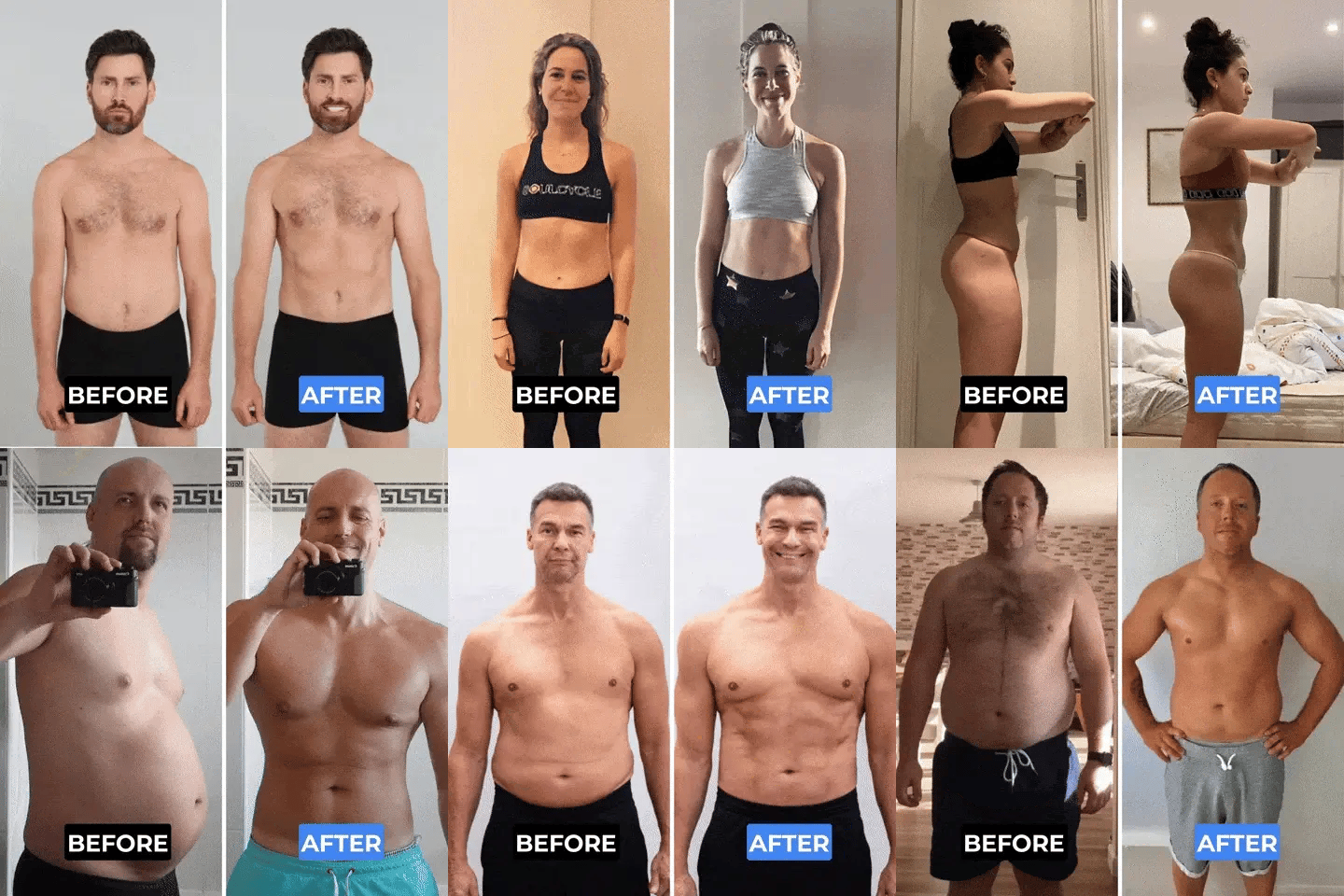
The Ultra comes with a 60-day money-back guarantee, and 60 days is exactly the window the timeline above runs on.
Use it for two full months. Feel the contractions. Feel the next-morning soreness. Watch the mirror.
If your core doesn't respond, send it back for a full refund. No questions asked.
It's 49% off right now, and it's HSA/FSA eligible through TrueMed.
Where Can I Get the Ultra Stimulator?
If this story connected some dots for you, here's the last practical piece.
The Ultra is sold only by APE BORN, and you can order it right on this page. Every button here takes you straight to the order section below, where you pick your quantity and check out directly.