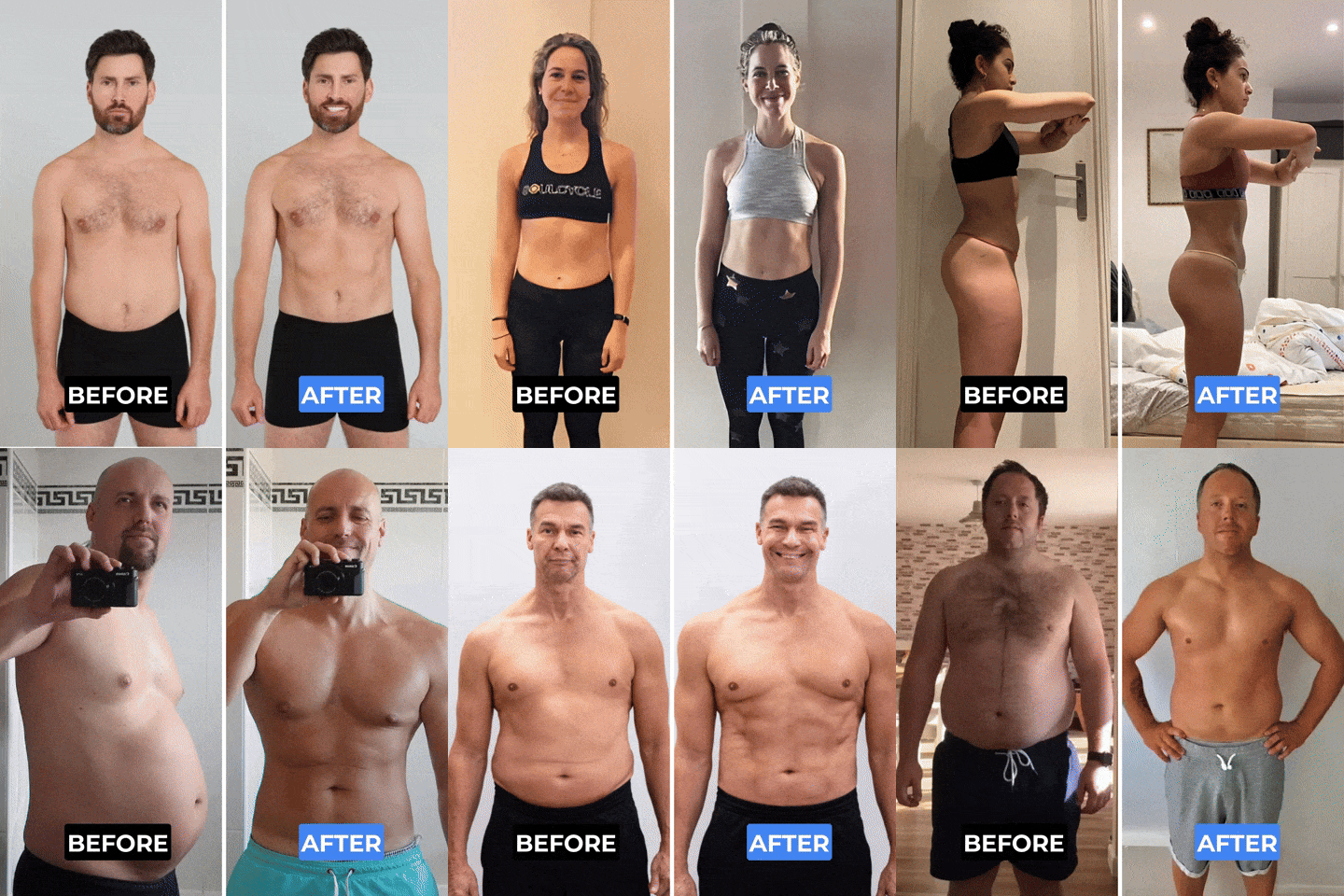
How a Clinical Technology That Increases Muscle Strength by 40% Is Giving Postpartum Women Their Core Back, Years After Doctors Told Them to "Just Accept It"

She was three years postpartum and still couldn't sneeze without crossing her legs.
Her abs hadn't "come back." The belly still pouched out under every shirt. Her lower back ached by noon — every single day. She'd tried crunches (they made it worse), a belly wrap (it smoothed the surface and changed nothing underneath), and a $200 "mommy tummy" program she quit after two weeks because she couldn't find 45 consecutive minutes between the toddler and the dishes.
Her doctor told her it was normal. "That's just what happens after kids."
She accepted it — until she didn't.
What she found wasn't a workout. It wasn't a wrap. It was a clinical technology originally built for post-surgical muscle rehabilitation — one that forces 600+ involuntary contractions in 20 minutes and has been shown to increase muscle strength by 40% in controlled studies.
And it's now being used by 145,000+ people from their couches.
This is the story of how that technology works, why it was hidden inside clinics for decades, and why postpartum women — some 10 or 15 years past delivery — are calling it the first thing that actually fixed their core.
The Problem No One Explains After Delivery

During pregnancy, the rectus abdominis — the paired muscles that run down the front of your stomach — separate to make room for the baby. That's diastasis recti. Most women have heard the term. Almost none have heard what actually happens next.
The muscles don't just separate. The neuromuscular connection between your brain and your deep core fibers weakens — and in many cases, it doesn't come back on its own. Your brain sends the signal to contract. The muscle barely responds. You do a crunch and feel it in your neck, your hip flexors, everywhere except your actual abs.
This isn't a strength problem. It's a recruitment problem. Your deep abdominal muscles — the transverse abdominis, the internal obliques, the fibers closest to the spine — are still there. They just stopped receiving the signal.
That's why crunches don't work. That's why planks feel wrong. That's why the belly wrap didn't change anything once you took it off. Every tool you were given assumed the connection was still intact. It wasn't.
The clinical technology that addresses this — Neuromuscular Electrical Stimulation, or NMES — was developed decades ago. It bypasses the brain entirely and sends a signal directly to the muscle, forcing a complete involuntary contraction. In clinical studies, it increased muscle strength by 40%. And until recently, the only way to access it was at a rehab clinic, at $150+ per session.
Why Everything You Tried Made It Worse — Or Did Nothing

Start with crunches. A crunch asks your rectus abdominis to shorten under load. When that muscle is separated or neurologically disconnected, the force doesn't go where it's supposed to. It pushes into the diastasis gap, spikes intra-abdominal pressure, and loads your lower back. Women who tried crunches to fix their postpartum core often watched their belly cone outward mid-rep. That's the connective tissue failing under a load it can't handle.
Crunches didn't fail because you did them wrong. They failed because they're the wrong tool for a disconnected core.
Wraps are different — they don't make it worse, but they don't make it better either. A wrap compresses the surface. It smooths. For a few hours, you see something closer to what you remember. But a wrap can't recruit muscle fiber. It can't restore a neuromuscular connection. The moment you take it off, your core is exactly as disconnected as it was before.
The YouTube "mommy tummy" routines sit somewhere in between — gentle enough not to cause damage, but too shallow to reach the deep fibers that actually need activation. They target the surface muscles your brain can still talk to. The ones it can't — the transverse abdominis, the deep internal obliques — never fire.
NMES works on a completely different principle. It doesn't ask the broken connection to perform. It bypasses it. The signal goes directly to the muscle and forces a full contraction — 600+ of them in 20 minutes — hitting deep core tissue that no voluntary exercise can reach. That's the mechanism behind the 40% strength increase. Not harder effort. Deeper activation.
The Technology Was Locked Inside Clinics for Decades

NMES wasn't originally built for postpartum recovery. It was developed for post-surgical rehabilitation — rebuilding muscle activation in patients who'd lost neuromuscular function after operations, injuries, or extended bed rest.
The principle was the same: the brain couldn't talk to the muscle anymore, so the device did it instead. Forced contractions. Deep-fiber recruitment. The 40% strength increase that showed up in clinical studies came from this exact mechanism — complete muscle activation repeated consistently, without relying on voluntary effort.
Physical therapists, sports medicine practitioners, and rehab specialists adopted it. 400+ clinicians through networks like FrontRowMD now recommend it. For years, if you wanted access to clinical NMES, you booked a session at a facility, lay on a table, and paid $150 or more per visit.
For postpartum women with diastasis recti, this created an impossible equation. The technology that could actually rebuild their deep core activation existed — but accessing it meant finding childcare, driving to a clinic, and paying per session, two to three times a week, for months. Most women tried a few sessions and stopped. Not because it didn't work — because the logistics didn't.
The technology that could fix the problem was sitting in a clinic, behind a paywall, while postpartum women at home were buying wraps and doing crunches that made it worse.
Why the Version You've Seen Is a Toy

If you've tried a cheap EMS belt off Amazon — maybe one marketed for "postpartum toning" or "mommy belly" — you already know how this goes.
It buzzed. It tingled. Maybe it felt like something was happening for a few minutes. Then you put it away and nothing changed.
Those devices use flimsy gel pads that lose conductivity after a handful of sessions. The signal barely penetrates past the skin. They're engineered to feel like muscle activation — not to actually produce it. They don't generate the depth of contraction that drives the 40% strength increase in clinical NMES studies. They don't reach the transverse abdominis. They don't rebuild a neuromuscular connection that's been offline since delivery.
The clinical-grade machines in rehab facilities use integrated electrode technology — direct-contact surfaces that drive the signal deep into the muscle belly. No gel pads. No degradation. No surface-level tingling dressed up as a workout.
That's the version that produces 600+ real contractions per session. That's the version behind the 40% data. And the gap between that version and the $30 Amazon belt is the difference between your abs actually firing again and another product in the drawer next to the belly wrap.
The Real Version, Built for Home

FDA-Cleared · 600+ Contractions · 145,000+ Sold
The Ultra Stimulator is the first home device that delivers clinical-grade NMES — the same mechanism behind the 40% muscle strength increase — without a clinic visit, without gel pads, and without a $150-per-session price tag.
FDA-cleared. 145,000+ units sold. Recommended by 400+ clinicians. HSA/FSA eligible through TrueMed.
It uses an integrated electrode design — the same type of contact surface used in clinical NMES equipment — not the cheap gel pads that degrade after a few uses. The signal reaches deep core tissue. The contractions are real. 600+ of them in a single 20-minute session, hitting the transverse abdominis and deep fibers that your brain stopped talking to after pregnancy.
This is the technology that was locked inside rehab clinics for decades — rebuilt for your living room, for your schedule, for the 20 minutes you have while the baby naps. With a 60-day money-back guarantee.
- ✓Clinical-grade NMES — the same mechanism shown to increase muscle strength by 40% in controlled studies
- ✓600+ deep involuntary contractions per 20-minute session — reaching the transverse abdominis and deep fibers no crunch can activate
- ✓Integrated electrode design — no gel pads to replace, no adhesive, no degradation, no surface-level tingling
- ✓FDA-cleared — same regulatory standard as clinical medical devices
- ✓145,000+ units sold · recommended by 400+ clinicians through networks like FrontRowMD
- ✓HSA / FSA eligible via TrueMed — pay with pre-tax health dollars
- ✓60-day money-back guarantee — full refund if you don't see results
What to Expect, Week by Week

Here's what rebuilding a disconnected core actually looks like — week by week:
Week 1: Your first session will feel different from anything you've tried. The contractions are involuntary — your abs fire without you telling them to. It's strange. It might feel intense. That's the NMES signal bypassing your brain's broken recruitment pathway and forcing deep fibers to contract for the first time in years.
Weeks 2–3: Your core starts responding faster. You may notice your posture improving — less lower back collapse by the end of the day. The deep ache after sessions is the same kind of deep-fiber soreness women describe after their best PT sessions. It means the right muscles are finally working.
Weeks 4–6: This is where the 40% mechanism compounds. The neuromuscular connection your brain lost after pregnancy starts rebuilding. Your abs engage when you lift your toddler. You bend over without bracing. The belly starts to flatten — not from compression, but from actual muscle activation pulling the wall back in.
Week 8+: 94% of users report visible toning by day 60. For postpartum women, this often means the "mommy tummy" profile starts disappearing. Lower back pain drops. Sneezing without crossing your legs. Standing straight without thinking about it. Not because you trained harder — because the deep core muscles that disconnected after delivery are finally back online.
Don't Just Take Our Word For It
145,000+ units sold. 400+ clinicians recommend it. The same core NMES technology was clinically shown to increase muscle strength by 40%.
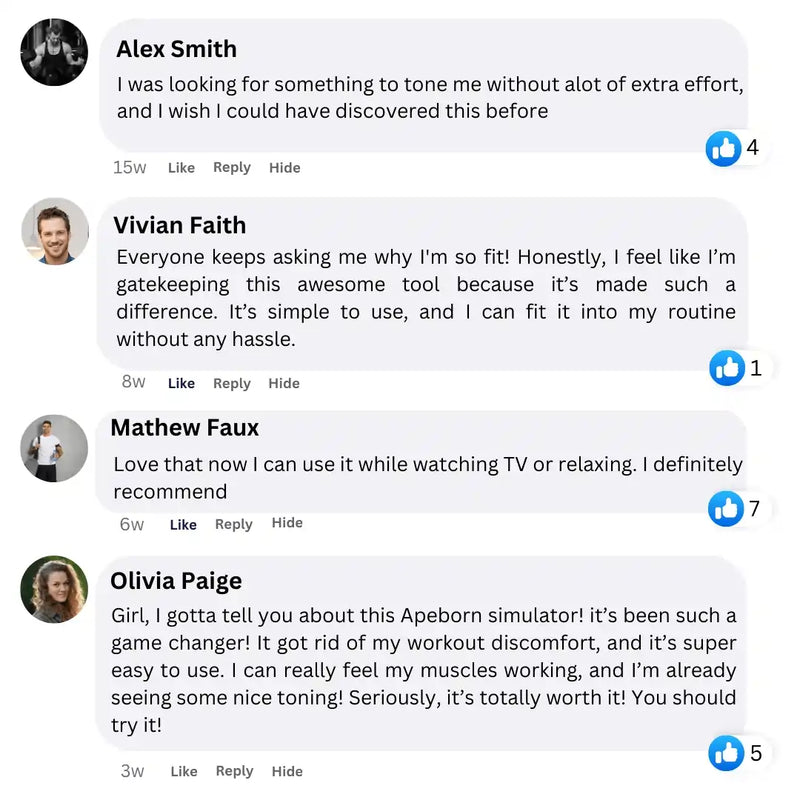
But don't take the science alone — here's what real users are saying:
“I recommend this product and this company. I can see my abs getting tighter and my ab muscles are beginning to pop after just two weeks of use. Thank you Ape Born!”
“After six months of using this Stimulator along with a balanced diet, I can honestly say this little device has exceeded my expectations. I've been using it almost daily, mainly on my arms and core, and the results are noticeable!”
“This is my 8 months journey while hitting the gym along with using these stimulators. The best part is it has velcro straps and not the gel pads like others. It surely is expensive than other machines out there but is worth the price.”
Try the Technology Risk-Free for 60 Days
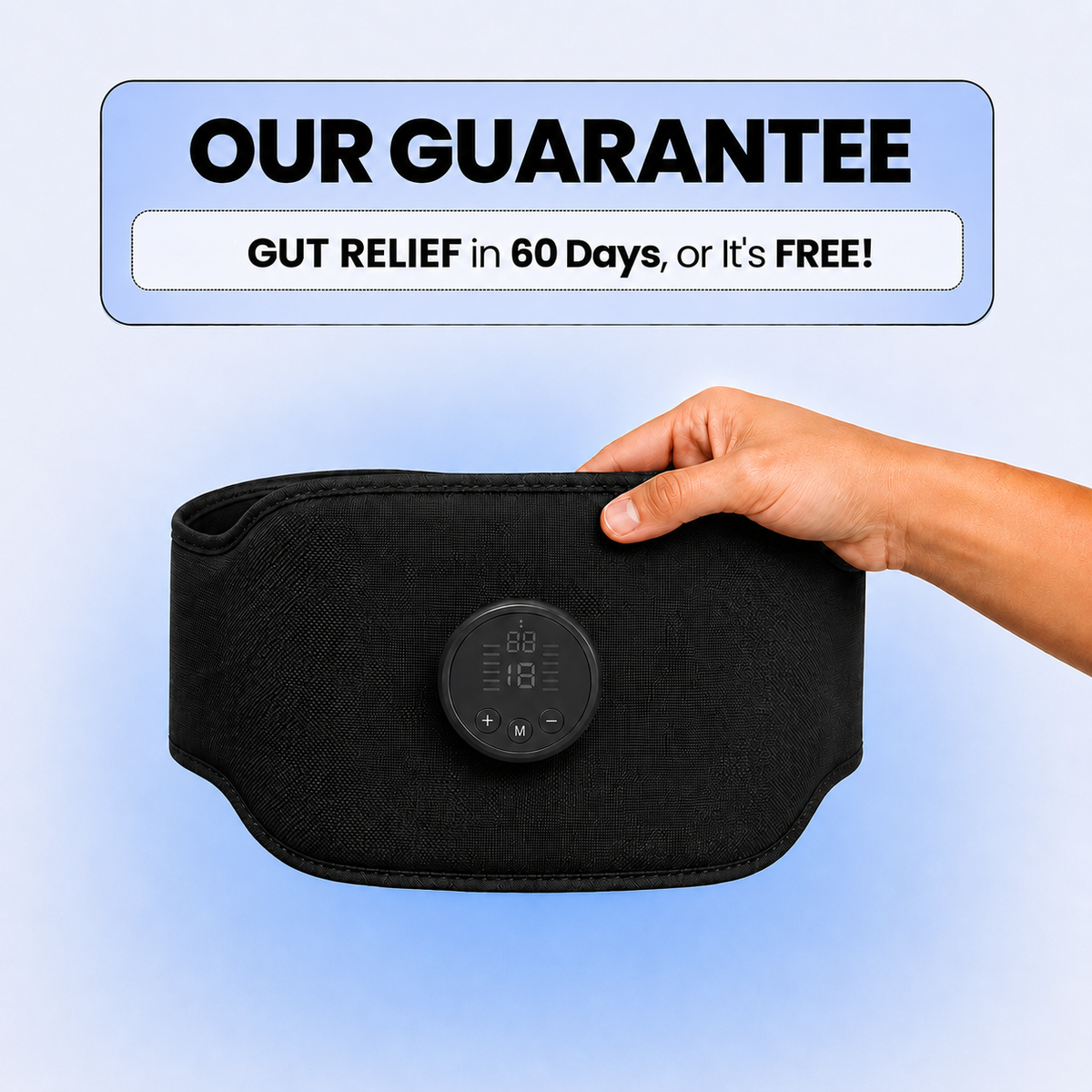
The clinical NMES technology that increases muscle strength by 40% — the same mechanism that was locked inside rehab clinics while you were told to "just accept it" — is now available for home use. FDA-cleared. No gel pads. No appointments. No per-session charges.
94% of users see visible toning within 60 days. If you don't, send it back. Full refund. No questions.
The Ultra Stimulator sells exclusively through apebornfitness.com and sells out regularly.
Where Can I Get the Ultra Stimulator?
If this story connected some dots for you, here's the last practical piece.
The Ultra Stimulator is sold only by APE BORN, and you can order it right on this page. Every button here takes you straight to the order section below, where you pick your quantity and check out directly.